
As companies adopt AI for decisions, the advantage moves upstream: to the quality of the question, the reliability of the data, and the judgment of the person deciding what happens next.
There is a particular kind of meeting happening more often now. When there’s no direction someone says, "Let's ask AI." A few seconds later, there is a directional answer on the screen. Often it sounds exactly like the thing everyone wanted to hear. In fact, it’s good enough to move on to the next task.
The room relaxes a little. Problem solved.
I understand it. We are all tired. We all have too many inputs, too many dashboards, too many possible moves, too many opinions dressed as certainty. An answer that appears in seconds feels like relief.
But relief is not the same as clarity.
This is the uncomfortable part of AI in leadership work: the machine can produce an answer before the team has agreed on the question.
For growth, that distinction matters. Because the question decides what data matters, which assumptions become visible, who needs to be in the room, and what kind of decision the business is actually making.
AI has answers. Leaders need questions.
AI is entering the decision room
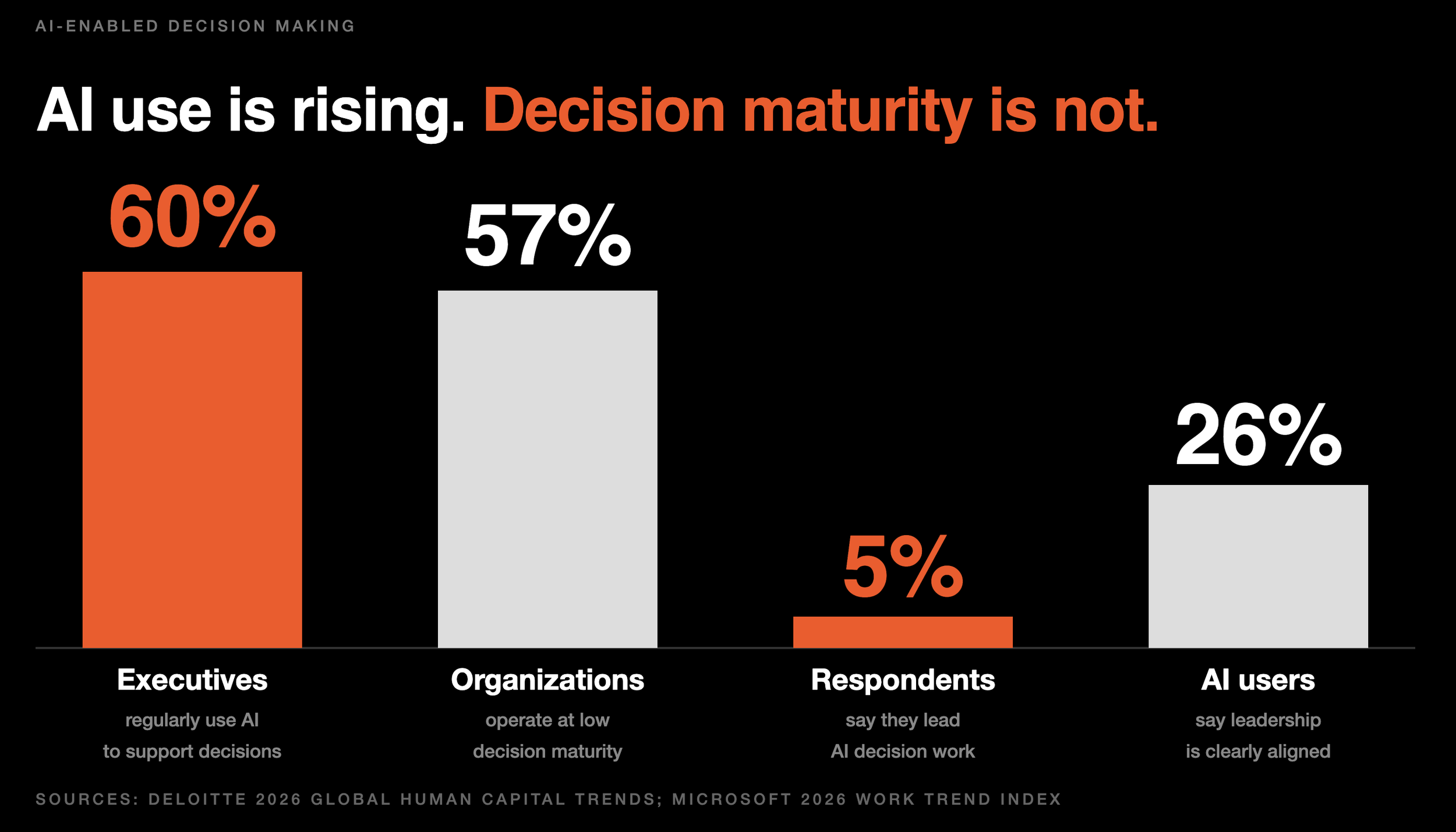
This is not a hypothetical shift anymore. Deloitte's 2026 Global Human Capital Trends research found that 60% of executives now regularly use AI to support decisions. Gartner projects that by 2027, half of business decisions will be augmented or automated by AI agents, according to the same Deloitte article.
That is not a small operational change. That is a change in how companies think, choose, justify, and move.
At the same time, the decision muscle inside many organizations is not as strong as the tooling around it. Deloitte also cites research showing that 57% of organizations operate at low decision-making maturity. In the same report, only 5% of respondents said they were leading the way on AI and decision-making.
This is where the gap opens: companies are putting AI into decisions faster than they are designing the decision process itself. But.
AI does not fix weak decision-making. It can amplify it.
The problem is not that AI is useless
OpenAI's own research on hallucinations describes them as moments when a model "confidently generates an answer that isn't true." Stanford's 2026 AI Index gives another useful warning: in one benchmark testing the difference between knowledge and belief, hallucination rates across 26 top models ranged from 22% to 94%.
This does not mean AI is wrong all the time. It does not mean teams should avoid it. It means AI output needs context, verification, and a human being who understands what kind of answer would be useful.
Especially in growth.
Because growth questions are messy and fuzzy. Which market should we enter? Why is pipeline slowing? Should we hire a senior marketer or a specialist? Is this a positioning problem, a product problem, a sales problem, or a trust problem? What should we do first?
AI can help with all of these. It can map options, summarize inputs, pressure-test assumptions, and generate useful alternatives.
But someone still has to formulate the question and know whether it’s the right one.
Better questions are not soft work
There is a strange bias in business toward visible output. A deck feels like work. A campaign feels like work. A new tool feels like work. A detailed answer from AI certainly feels like work.
But the (sometimes lengthy) act of sharpening the question can look, from the outside, like delay.
MIT Sloan Executive Education published a 2026 discussion with Hal Gregersen on the leadership skill AI cannot replace: asking better questions. Gregersen's "Question Burst" method asks leaders to spend three to four minutes generating only questions about a challenge, with no explanations or answers. MIT reports that in 85% of cases, the challenge becomes reframed, emotional tone improves, and new ideas begin to emerge.
This is important because many business problems are not solved by the first answer. They are solved when the problem changes shape:
Maybe the issue is not that leads are bad. Maybe sales and marketing disagree on what a good lead means.
Maybe the issue is not that the team needs more content. Maybe the company has no point of view sharp enough to turn into content.
Maybe the issue is not that the GTM stack is underpowered. Maybe the team does not have a shared understanding of how the product grows.
Maybe the issue is not speed. Maybe the issue is direction.
This is why experienced operators can be so useful inside companies that are under pressure. They do not only bring answers. They bring pattern recognition. They notice when the room is solving the visible problem while avoiding the actual one.
The question is often where the value starts.
What changes in the AI era
Before AI, a weak question was already expensive. In the AI era, it becomes faster. That is the part worth taking seriously. Because if a team asks AI to build a campaign before clarifying the audience, it will get some type of a campaign.
AI is obedient in a dangerous way. It will often answer the question you asked, even when the better work would have been to challenge the question.
This is why the leadership layer becomes more important, not less.
Microsoft's 2026 Work Trend Index argues that as AI agents take on more execution, humans have more room "to direct the work, make the calls, and own the outcomes." The same report found only 26% of AI users say leadership is clearly and consistently aligned on AI.
There is the gap again. The tools are moving. The operating model is slower. The people using AI are often ahead of the organization around them.
So the work is not only adoption. It is alignment. It is decision design.
It is knowing where AI should generate, where it should challenge, where it should summarize, where it should stay out, and where a human should be fully accountable.
A question-led way to use AI
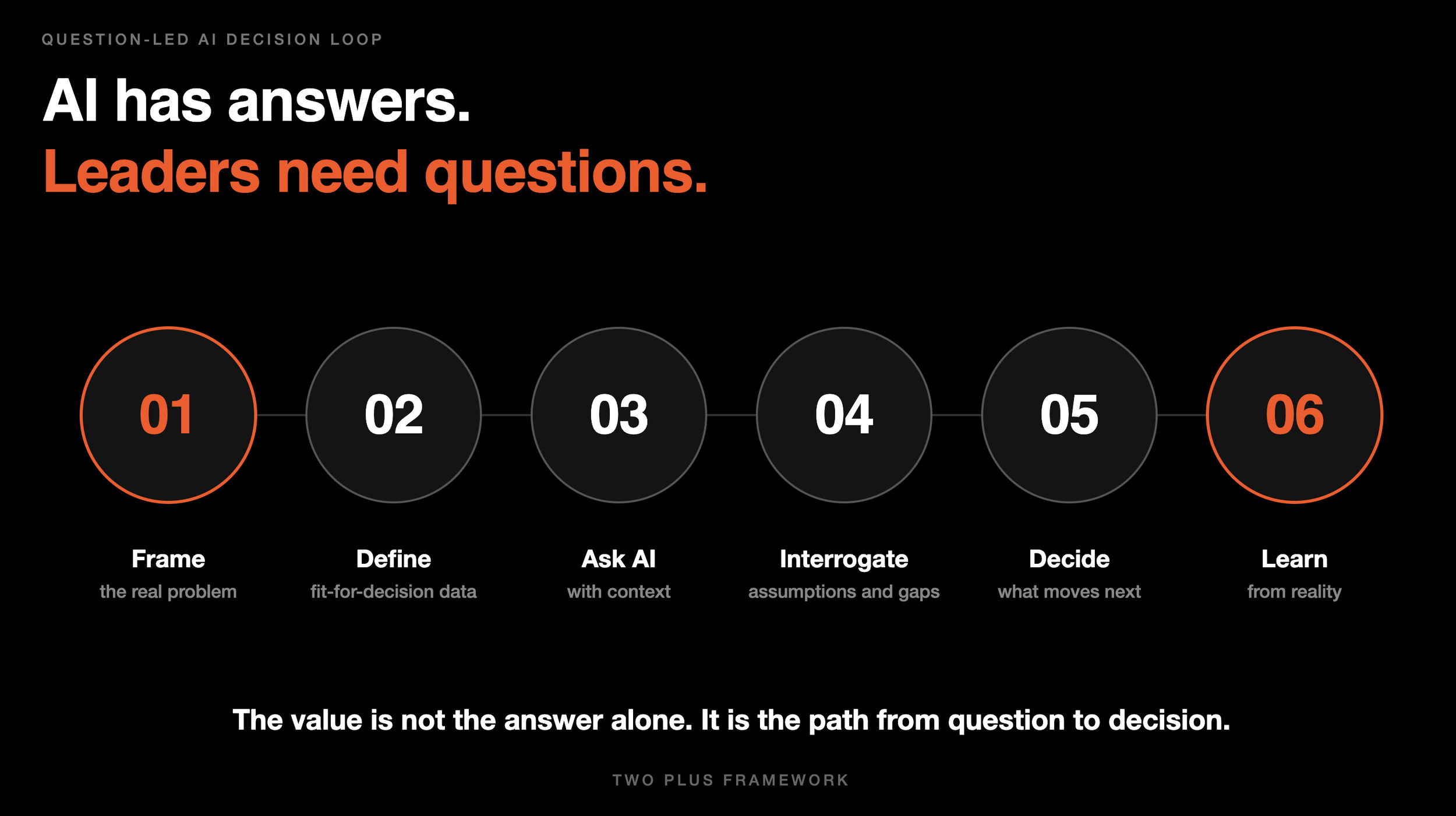
For growth work, I like a simple sequence.
First, frame the real problem. What is actually happening? Where does the business feel friction? What would change if we solved it?
Then define the evidence. What data do we trust? What do we know from customers? What do we know from sales conversations, product usage, retention, pricing, channel performance? What is missing? What are we assuming because the spreadsheet looks polite?
Then ask AI. With a lot of context, constraints, source material, the decision in mind. Not as a magic surface, but as a thinking tool.
Then interrogate the output. What did it miss? What did it assume? Which recommendation depends on weak data? Where does it sound plausible but empty? Which part feels like it came from the average internet, and which part is actually useful?
Then decide the next move and learn from reality because the market is still the final editor.
Why this matters for growth-stage companies
Growth-stage companies rarely suffer from a lack of options. Even with limited budgets the real scarcity is not options. It is judgment.
Which customer segment matters first?
Which metric is telling the truth?
Which assumption has become comfortable?
This is where senior growth leadership earns its place - by creating the conditions for better decisions. That means asking better questions. Building from reliable data. Understanding the commercial system. Seeing the team dynamics around the work.
And turning the answer, once it is good enough, into execution.
Sources
Deloitte Insights, "AI and the future of human decision making", March 2026.
MIT Sloan Executive Education, "The Leadership Skill AI Can't Replace: Asking Better Questions", March 2026.
Microsoft WorkLab, "Agents, human agency, and the opportunity for every organization", May 2026.
Stanford HAI, "Responsible AI: The 2026 AI Index Report", 2026.
OpenAI, "Why language models hallucinate", September 2025.
Harvard Business Review, "The Art of Asking Smarter Questions", May-June 2024.
