
GTM is the commercial system that turns one into the other.
In April 2020, Quibi launched with $1.75 billion in funding, Hollywood’s biggest names, and a library of premium content built by people who had run studios. Six months later it shut down, having burned roughly $1.4 billion and converted about 500,000 paying users. The product mostly worked. The content won Emmys. What Quibi never had was a commercial answer: who is this for, why now, why pay, and why stay.
That’s the gap Go-to-Market exists to close. And it’s why GTM is one of those terms that gets used often and defined rarely. It shows up in investor conversations, launch plans, hiring decisions and strategy workshops. Most teams agree it matters. Fewer agree on what it includes. For some it means marketing. For others, sales. Sometimes a launch plan, a channel strategy, a positioning exercise.
All of these can be part of GTM. None of them are GTM on their own.
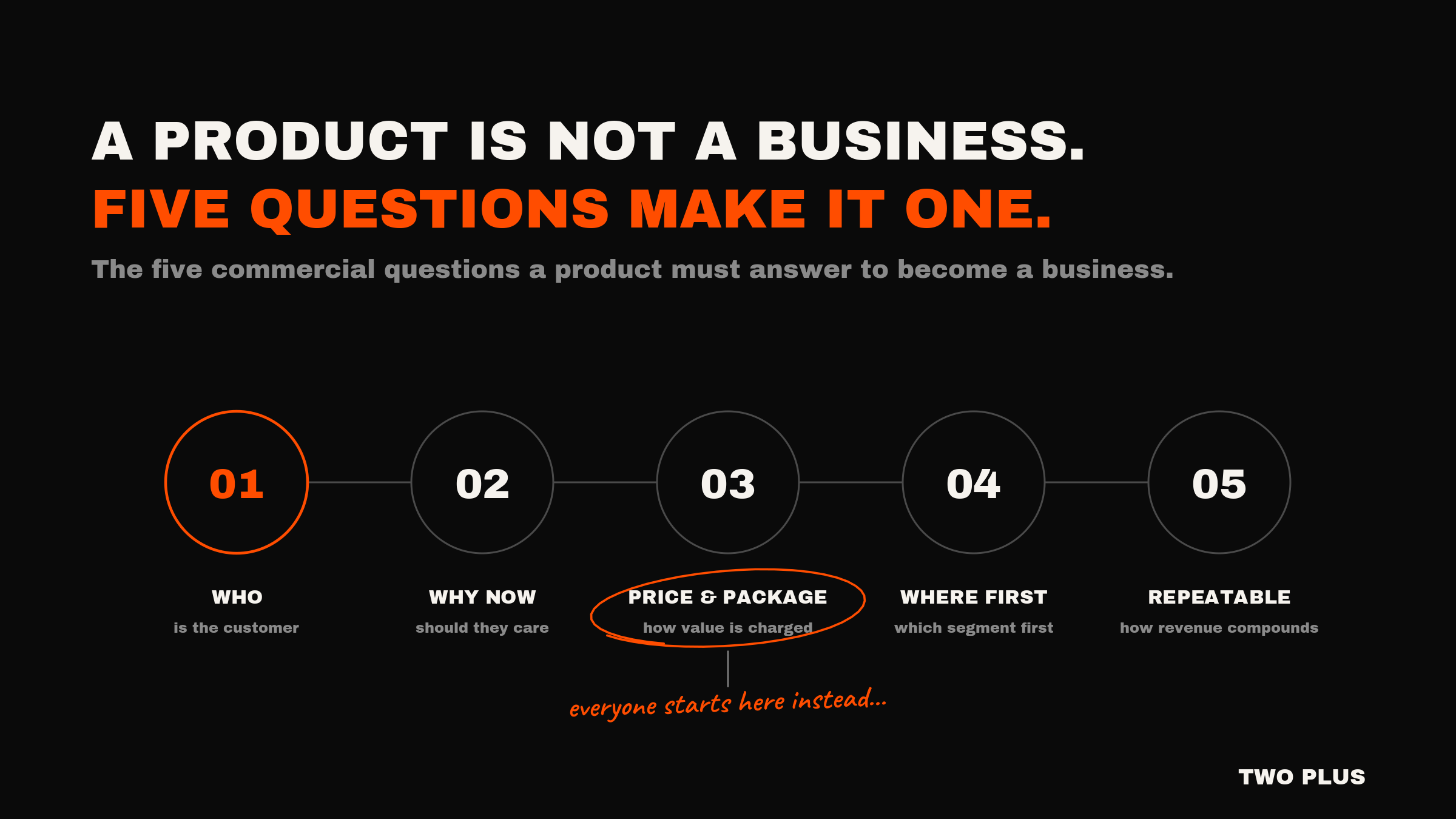
GTM is how a company connects product value to customer demand, revenue, and profitable growth. Who is this product for? What need does it solve, and why should the customer care now? How should it be priced and packaged? Which segment or market comes first? How does customer value become revenue, and how does that revenue become repeatable?
That is the work.
The most expensive assumption in business
Many companies assume that if the product is strong enough, the market will figure it out.
Quibi is what that assumption costs at the top end. But the more instructive version is Segment, because Segment ran the experiment twice with the same team.
Segment spent eighteen months and two products failing to get traction. In December 2012, nearly out of money, the founders open-sourced a small JavaScript library they had built for themselves - a utility that sent analytics data to multiple tools at once. It took off on its own. The team rebuilt the company around what the market had just told them it valued, hit $1 million in revenue within a year, and eventually sold to Twilio for $3.2 billion.
Same founders. Same technical ability. Same effort. The variable that changed was commercial clarity: a specific customer, a specific problem, and a product framed in the language of that problem.
Customers do not buy features in isolation. They buy progress toward a goal, reduction of risk, lower cost, higher speed, a clearer path forward. Good GTM starts with that customer reality and translates what the company has built into something the market understands, values, and is willing to pay for.
That translation is strategic work, not a copywriting task.
Monetization is more than a price tag
Product monetization usually gets reduced to one question: how much should we charge?
That question matters, but it comes last, not first. Before price, there are deeper decisions. What value does the product create, and who captures it? Which segments have the highest willingness to pay? What belongs in the core product, and what sits in premium tiers, add-ons, usage, or enterprise packaging? What does the customer need to experience before the value is obvious? What model supports both adoption and margin?
Three well-known companies show how much of monetization has nothing to do with the number on the pricing page.
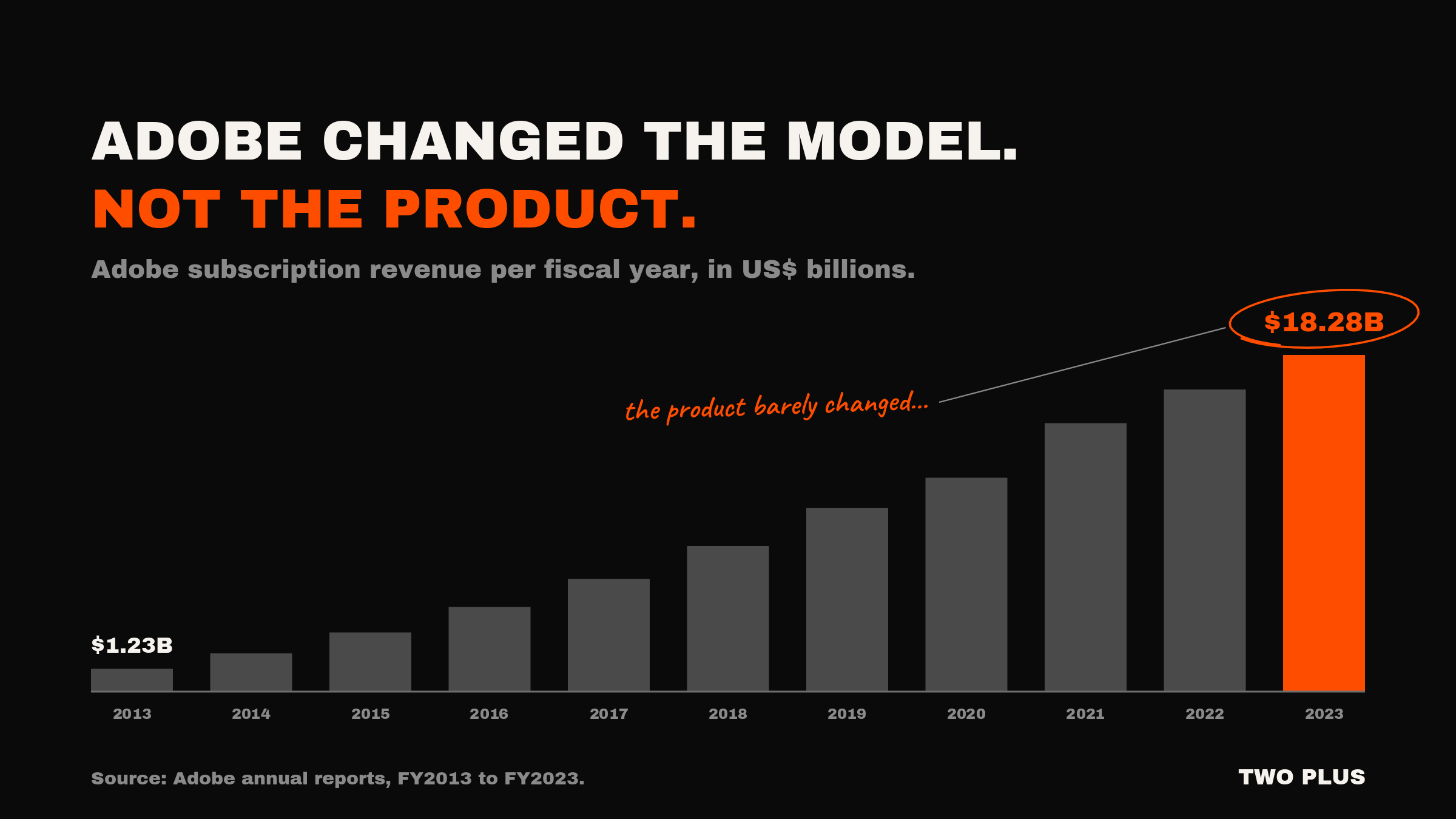
Adobe changed the model, not the product. In 2012 it began moving Creative Suite from perpetual licenses to Creative Cloud subscriptions. Revenue dipped while customers adjusted - then subscription revenue climbed from $1.23 billion in 2013 to over $18 billion a decade later. Largely the same tools; a different commercial logic.
HubSpot changed the value metric. For years it charged for every contact stored in the database, including bounces and unsubscribes. In 2020 it introduced Marketing Contacts: customers pay only for contacts they actually market to. The price didn’t drop so much as the metric finally matched the value customers felt they were getting.
Slack changed what billing says about the company. Its Fair Billing Policy automatically credits customers for inactive seats - nobody pays for people who don’t use the product. A billing detail became a trust signal, and a trust signal became a growth engine.
This is why monetization is not a finance decision. It is a product, customer, and growth decision. A company can have the right product and the wrong package. The right market and the wrong entry point. The right buyer and the wrong value metric. Strong GTM identifies where value is created, how customers perceive it, and how the company captures it profitably.
Profitable growth requires focus
Growth work tends to expand: more campaigns, more markets, more channels, more partnerships, more experiments.
That can look like momentum. Often it is just motion.
GTM forces sharper choices. It gives the company a commercial thesis: where to play, how to win, and what must be true for growth to compound. Without that thesis, every function optimizes its own version of success. Marketing optimizes for leads. Sales optimizes for pipeline. Product optimizes for features. Finance optimizes for margin. Leadership optimizes for the next board update.
Growth does not compound when everyone is winning a different game. GTM is the operating logic that connects them.
Expansion is not copy-paste
GTM matters most when a company wants to grow beyond its current base - a new segment, a new geography, a new product line, a new buyer inside the same account, a new monetization model.
This is where the work gets underestimated. What resonates with early adopters may need a different message for mainstream buyers. A sales motion that works with founders may collapse against enterprise procurement. A pricing model built for one use case may break when applied to another.
Good GTM helps companies decide not only where they could grow, but where they should. Not every opportunity is strategic. Some create revenue but add complexity. Some create awareness but weaken positioning. Some add users but damage margin. The role of GTM is to connect growth ambition with market reality.
The symptoms are familiar
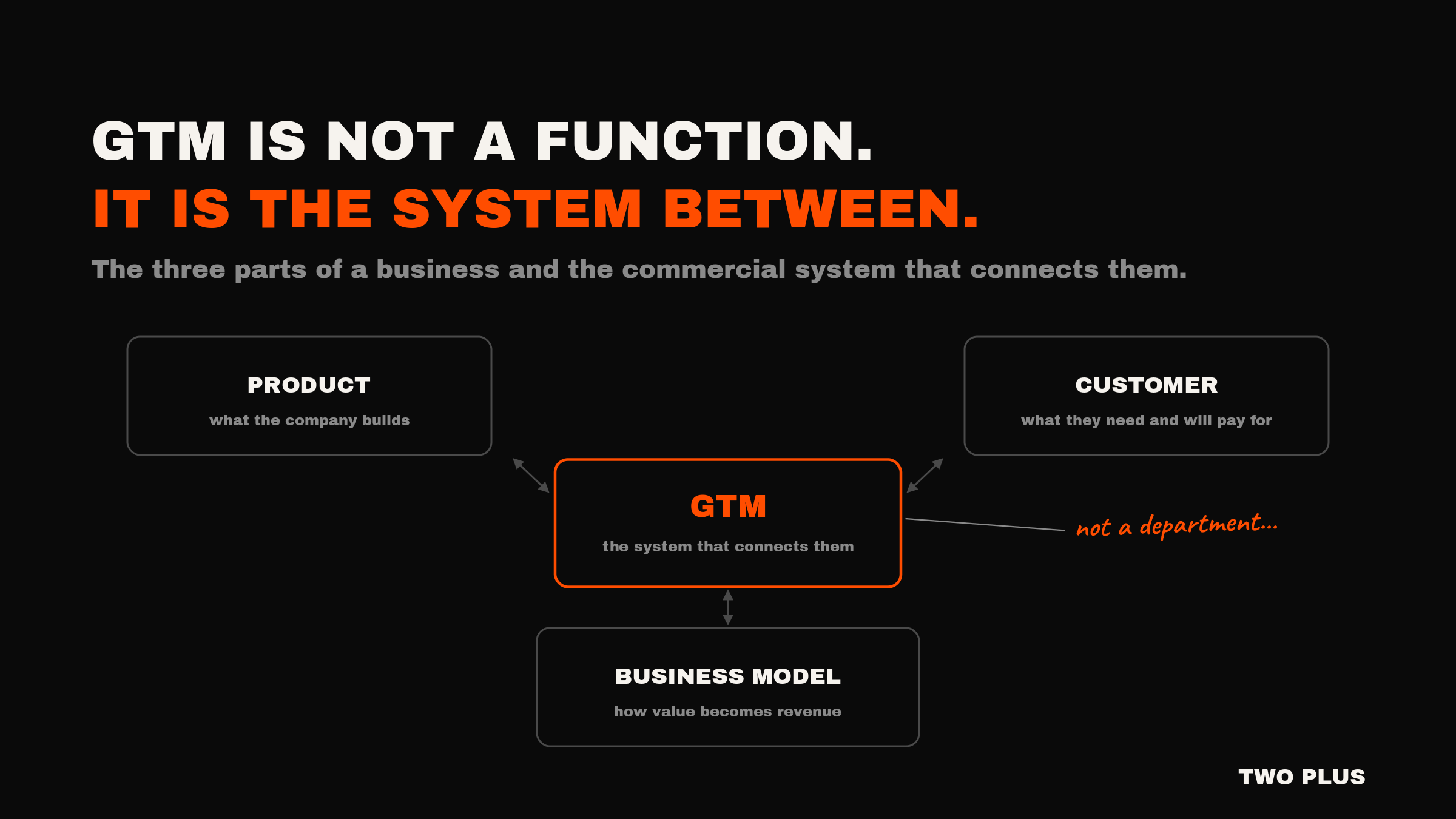
The strongest GTM work sits between functions. It is not only marketing, or sales, or product strategy. It is the system that connects them - and when the parts are disconnected, you can feel it.
The product is good, but customers don’t understand why it matters. Marketing is active, but pipeline quality is weak. Sales is busy, but conversion is slow. Revenue is growing, but margins are under pressure. The company is entering new markets, but the message feels generic. The team is doing a lot, but the business is not moving in proportion to the effort.
That is usually not a single-function problem. It is a GTM problem.
Let’s ask some honest questions
Five questions, in place of a strategy offsite:
Can your team state, in one sentence, who the product is for and why they should care now?
Does your pricing metric match the way customers experience value - or the way it was easiest to bill?
If you stopped all new campaigns for a quarter, would your growth thesis still be clear?
What is the last expansion opportunity you said no to - and if you can’t remember one, who is making the trade-offs?
If marketing, sales, product, and finance each wrote down what winning looks like, would the answers match?
If your answers lean on effort, features, or more activity, the gap is not execution. It is commercial clarity.
What we mean when we say we do GTM
At Two Plus, we use GTM in a practical, commercial sense: we help companies meet customer needs profitably.
Depending on stage, product, and market, that can mean product monetization - pricing, packaging, value metrics, commercial model design. It can mean identifying the segment where the product has the strongest right to win. Entering a new market with a clearer thesis. Shaping a category, or repositioning inside one. Translating technical capability into business value, so customers understand why the product matters and why now. Or building a more repeatable growth system across product, marketing, sales, and revenue.
The work changes. The principle does not.
The bottom line
Go-to-Market is not a campaign, a launch, or marketing with a more strategic name. It is the commercial system that connects what a company builds with what customers need, what they will pay for, and how the business grows.
Quibi had $1.75 billion and no answer to those questions. Segment had almost nothing left and found one. The difference was never the product.
In markets where technology is easier to build, competition moves faster, and customers have more choice, the companies that win will not simply have the strongest products. They will understand their customers clearly, monetize value intelligently, choose their markets deliberately, and build growth systems that compound.
A product earns attention. GTM earns the business.
